
Trace Crawford County’s Prior Owners
Start with the newest deed and work backward. Each deed names a grantor. That same person should appear as the grantee one row earlier, so every link in the Crawford County chain of prior owners is confirmed before you climb another step.
| Transfer date | Grantor → Grantee | Deed type | Book/Page |
|---|---|---|---|
| Newest recorded transfer | Prior owner → current owner | Copy the instrument label | Instrument or book/page |
| Earlier recorded transfer | Earlier owner → prior owner | Copy the instrument label | Book/page citation |
| Next earlier transfer | Predecessor → earlier owner | Copy the instrument label | Book/page citation |
Match the legal description at every single step. Along the way you may meet a warranty, quitclaim, executor, sheriff's, tax, correction, or transfer-on-death deed. Labels alone never prove the chain is clean.
Read Crawford Deeds Backward
The Recorder keeps alphabetical grantor and grantee indexes, and each entry carries a short land description, the deed date, and a book and page reference. Search both party sides.
- Find the latest deed to the current grantee and copy its citation.
- Verify township, section, lot, block, plat, or metes-and-bounds description.
- Search that deed’s grantor as a grantee on an earlier deed.
- Repeat while recording name variants and every cross-reference.
- Check probate, court, plats, and tract books when the direct chain breaks.
For the mechanics of pulling a single instrument, see the Crawford County deed records resource. A backward owner search, by contrast, is about keeping the chain unbroken across time.
Crawford’s Separate Deed Indexes
An Indiana State Library finding aid documents grantor indexes covering 1818 to 1898. It then covers 1898 to 1926 in a second span. Grantee indexes run from 1818 to 1878. Overlapping volumes extend through 1898, plus a later volume reaching 1926. Each party side sits on separate reels, so searching only one side can hide previous owners entirely. The official Crawford County office directory is the dependable online route to the Recorder. The county publishes no direct public deed-index link.
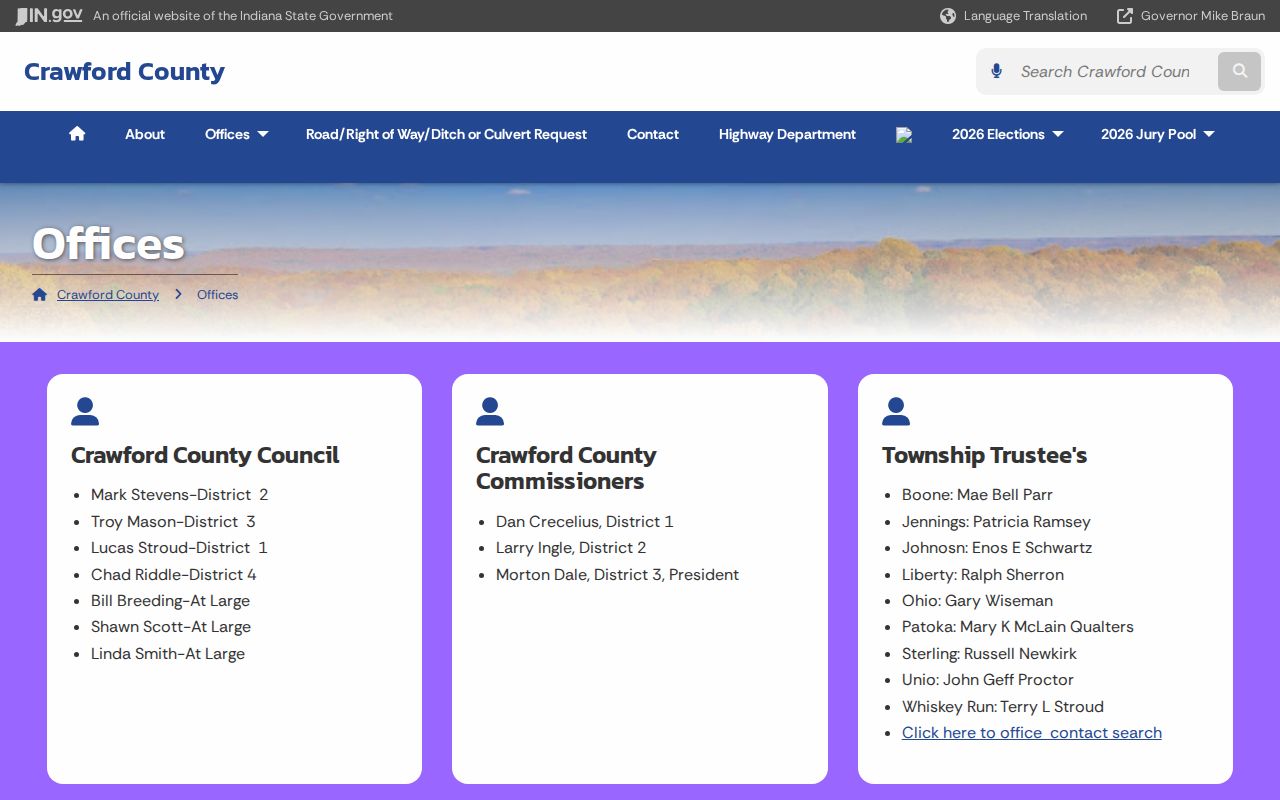
The county office page lists contacts, but it is not itself a deed result. Phone or counter requests will pull a cited index entry and its image. Deed Book A spans 1818 to 1834. The microfilm volumes continue through Book 41 and into 1901. The indexes run later still. Some volume years overlap. So cite the exact reel, volume, and page rather than a guessed year.
Crawford Ownership-Chain Terms
The old books use short index terms. Keep these distinctions in the research log.
- Grantor
- The party conveying an interest.
- Grantee
- The party receiving it.
- Chain of title
- The linked series of instruments affecting the same land.
- Reverse index
- The receiving-party side, commonly the grantee index.
- Quitclaim and warranty deed
- Different conveyance forms; neither name replaces review of the full chain.
Crawford Owner Records Reach 1818
Crawford's documented deed trail opens with the county's founding in 1818. Tract records reach back to 1804. That predates Crawford itself, which was carved from Harrison, Orange, and Perry counties. No official account records a courthouse fire or a lost decade of land books. Test the volumes themselves instead of assuming either perfect survival or destruction.
Digital cutoff unknown. Crawford’s exact online deed range was not confirmed. Older owners remain in deed books and State Library microfilm.
A spring 2025 recorder newsletter described a project to digitize, import, and index every Crawford document. Work in progress, though, is not the same as full online access. Call Recorder Christian Howell at 812-338-2615 for current coverage, images, and counter access.
Probate Bridges Crawford Owners
Land can pass through a will, estate order, or heirship finding. It can also move by executor or administrator deed, affidavit, partition deed, or transfer-on-death instrument. Search the decedent in MyCase. Search the estate representative there too. Then ask the Crawford Clerk for unposted or older papers. State Library holdings add will abstracts from 1818 to 1916 and a will index through 1973. They also hold probate order books from 1839 to 1920 and will records through 1946. A will tells you intent. The recorded instrument is what ties that event to the land chain.
Old Crawford Names Hide Owners
English was once called Hartford. Marengo hides Big Springs, Spring Town, and Jimtown clues. Leavenworth, Fredonia, and Mt. Sterling all figure in county-seat history, and Leavenworth itself moved after the 1937 flood. Older deeds may point to a township, section, plat, creek, road, or adjoining owner rather than a modern street. Historic town and floodplain maps from the 1970s can orient the search. The 1995 and 1999 Harrison-Crawford plat directories help too. Those aids are not recorded plats, so confirm the legal description at the Recorder.
Reach Crawford Deeds Offline
The Recorder counter sits at 715 Judicial Plaza Drive. Requests can also go by telephone, mail, or a focused written request under Indiana's Access to Public Records Act. Ask for a named index entry, volume, page, and land description. Inspection is generally free; copy and certification fees may apply. The Indiana State Library Crawford guide maps the microfilm route. Crawford County Public Library adds newspapers back to 1838. It also holds family files, cemetery files, and local images. Its remote research may take two to three weeks. It is capped at two hours per request within any two-week period.
Lawful historical use. Trace former owners for title, estate, purchase, or house-history needs. Never use old or current owner details to target or harass anyone.
Follow Crawford Deed Volumes
The State Library microfilm sequence turns a vague historical search into a volume plan. Deed Records volumes 1 through 3 span 1818 to 1843. Volumes 3 through 5 cover 1843 to 1851, and volumes 6 through 10 continue through 1865. Later runs proceed through volumes 11 to 25 and then 26 to 41, carrying recorded deeds into 1901. Because the year ranges overlap, a transfer near a boundary year may appear on either adjoining reel.
Write down the GSU reel identifier with the volume and page. The early grantor index appears on reel 1377983, while grantee material continues on reel 1377984. Later index volume 3 appears on reel 2439010. These are catalog references, not substitutes for the recorded page. They let library staff or a FamilySearch affiliate locate the right image without repeating a broad surname search.
Crawford Tract Records Precede Deeds
Tract books reach back before the deed chain does. Crawford County's documented tract series runs from 1804 to 1855. Later volumes cover 1869 through 1874 and 1884 through 1890. The earliest span predates the county itself. A parcel may trace to Harrison, Orange, or Perry County. That parent-county context often decides where the original land entry lives.
Match any tract-book name to section, township, range, acreage, and later deed language. A shared surname alone proves nothing. Two entries under one spelling can belong to different families entirely. Early descriptions lean on waterways, roads, corners, and adjoining owners. All of these shift over time. Historic county maps and the current parcel location help translate those calls. Still, only the recorded chain confirms the true sequence.
Crawford Newspapers Fill Owner Gaps
Newspapers fill the gaps that deeds leave open. The Crawford County Public Library holds microfilm beginning in 1838. That run captures estate sales, sheriff's sales, road work, construction, and local business changes. Such notices can explain why a name drops out of a deed chain. They can also show why land carried an older place name. The library also keeps family histories, cemetery files, yearbooks, and the Memories of Crawford County collection.
A newspaper mention is never ownership proof. Treat each date, surname, street, executor, or sale notice as a lead. Then go back to the grantor and grantee indexes. The State Library reports no Crawford city-directory run in its collection. Annual directories cannot be presumed. Remote Crawford-specific research is limited and may take two to three weeks. It still cannot replace reading the land records themselves.
Preserve the Crawford Owner Chain
Document every link the same way. Capture the instrument date and recording date. Note the grantor, grantee, and deed type. Add the book/page or instrument number and the full legal description. Record spelling variants as written. Do not silently correct the index. Keep images and citations in reverse order while working backward. Then read the chain forward once complete. That forward pass exposes gaps and overlaps. It also reveals any grantor who never appeared as an earlier grantee.
A gap means more records, not an invented owner. Look to correction instruments, probate, partition, sheriff's deeds, tax deeds, and plat changes. Where the chain will support a purchase or legal decision, have a qualified title professional evaluate it.
Keep the current tax parcel as a finding aid only. Never force a modern parcel number onto an early deed. Such deeds were indexed by names and land description.