
Crawford County Tax Record Fields
Three Crawford County offices split the work. The assessor builds the market value-in-use figure and the property characteristics behind it. The auditor keeps the tax list and applies deductions. The treasurer sends the bills, takes the payments, and manages delinquency. A complete picture comes from joining all three by parcel number. No single screen holds the full tax file.
| Field | What It Shows | Where |
|---|---|---|
| Parcel and district | Tax-roll identity and taxing area | Auditor tax list |
| Assessed value | Market value-in-use set through mass appraisal | Assessor parcel record |
| Deductions | Approved reductions such as homestead or mortgage deductions | Auditor |
| Tax bill | Amount billed for the pay year | Treasurer or Gateway |
| Payment status | Paid, due, or delinquent amount | Treasurer tax site |
| Sale notice | Parcel placed into the delinquent-tax sale process | County notice and Zeus Auction |
Indiana assesses real property at a 100 percent assessment ratio using market value-in-use. That standard is a tax valuation, not a prediction of sale price. Each year, trending applies local sales data to update the mass-appraisal values. The final bill then layers on taxing districts, rates, deductions, exemptions, and credits. A deed's recorded consideration stands apart as its own transaction fact.
Crawford County Tax List
The county's Auditor tax list is the most useful public discovery tool for Crawford County property records. It takes a property or parcel number, a name, or a property address. Its own warning notes that entering too much information can narrow results. Start with one strong key. For a person, try the last name alone before adding a first name or initial.
| Search field | Required | Best use |
|---|---|---|
| Dist# | No | Narrow by taxing or assessment district |
| Parcel # | No | Match an exact local parcel key |
| Name | No | Find one owner's parcels, starting with surname |
| Tax Year | No | Choose the relevant roll year |
| Property Address | No | Find a street or rural-road entry |
The tax list shows a last-updated date of September 3, 2026. It reports 12,562 records and displays items 1 through 100 with a Maximum control. Each row lists district and parcel number. An RE-style key appears where present. Owner name, property address, city, state, and ZIP round out each entry. The list states it is not for official use. Confirm any balance or value with the responsible county office before acting on it.
Look Up Crawford Property Tax
The parcel number is your bridge from assessment data to the actual bill. Crawford's official county hub links the county tax payment site. The statewide Indiana Gateway Tax Bill Lookup offers a second channel when a county screen is unavailable.
- Find the parcel in the Auditor list by address, surname, or exact parcel number.
- Copy the district, parcel key, owner string, address, and tax year. Do not retype the long key from memory.
- Search the county tax site or Gateway. In Gateway, choose Pay Year and Crawford County, then add parcel, taxpayer name, address, district, or bill range only as needed.
- Read the current bill and payment status. Compare deductions against the Auditor record and contact the treasurer about any delinquency or sale notice.
- Assessed value
- The official tax valuation before the bill calculation.
- Levy or tax rate
- The amount imposed by the relevant taxing units and applied through the tax calculation.
- Homestead deduction
- An approved reduction for a qualifying principal residence.
- Tax lien
- A legal claim tied to unpaid property taxes.
Gateway asks for a Pay Year and County. Optional fields include Taxing District or Unit, Taxpayer Name, Address, Parcel #, a district-rate range, a total-bill range, and a sort choice. County formats vary. If a name search misses the record, try swapping first and last name order. You can also add a middle initial. The Gateway search page documents this statewide channel for Crawford County property tax records.
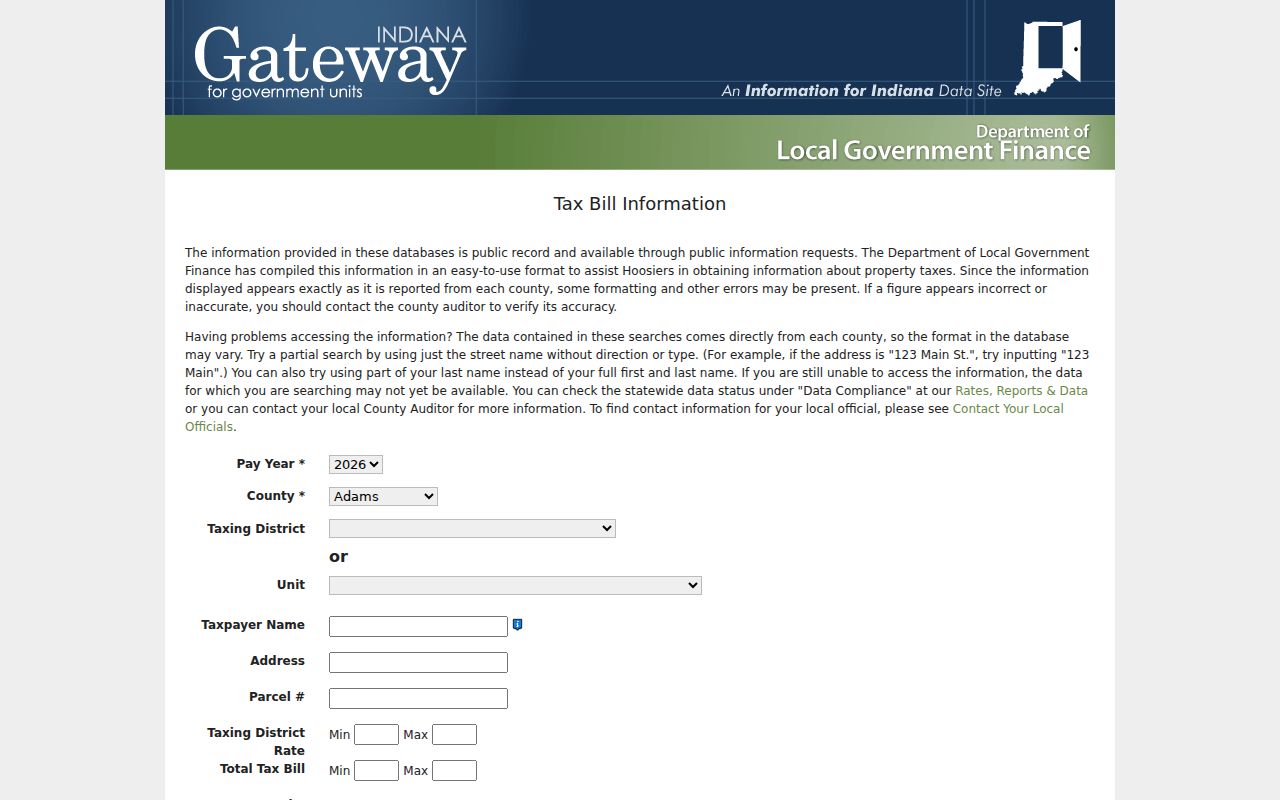
Gateway relies on county data. Check its display against the Crawford County treasurer for an official payoff figure or current payment status.
Crawford Property Tax Due Dates
The official Crawford Assessor page lists May 10 and November 10, 2026 as the two due dates. It directs payment to the treasurer. When a deadline lands near a weekend or holiday, ask how the office applies it. A web balance can lag behind a mailed or counter payment. Treasurer Jennifer Jones Davis sits at 715 Judicial Plaza Drive, English, IN 47118, phone 812-338-2651. Published hours are Monday and Friday 8:00 a.m. to 4:00 p.m. Tuesday and Thursday hours run 8:00 a.m. to 6:00 p.m. The office is closed Wednesday. Ask about accepted payment methods, convenience fees, receipt records, delinquency, and payoff figures.
Property tax offices
Assessor: 812-338-2402, assessor@crawfordcounty.in.gov
Treasurer: 812-338-2651, treasurer@crawfordcounty.in.gov
Location: 715 Judicial Plaza Drive, English, IN 47118
Crawford's 2026 Reassessment Cycle
The Indiana Department of Local Government Finance says a new statewide cyclical reassessment starts July 1, 2026 for 2026 Pay 2027 taxes. The cycle runs four years, through 2030. It inspects about 25 percent of parcels each year. Crawford County property tax records may therefore change in phases rather than through one countywide refresh. Physical inspection and annual trending play different roles. Reassessment revisits property data and value. Trending applies market evidence between the broader reviews. When a value shifts, compare the land, improvement, and total assessment components if the parcel card provides them. Year labels matter when you compare records. An assessment year, a pay year, a sale date, and a bill due date can all point to different moments in the cycle. Save each label with its amount. Then ask the assessor which property facts drove a change, and the treasurer which pay-year balance remains due. That habit keeps a valid reassessment from being mistaken for a payment problem or a recent sale. Note: A tax assessment is neither a boundary survey nor proof of clear title.
Crawford Tax Deductions
In Crawford County, the auditor handles deductions and exemptions while the assessor sets value. Indiana's common programs cover homestead, mortgage, age-based, veteran, disability, and other property-specific relief. Each has its own rules. Eligibility, filing dates, occupancy, ownership, and proof requirements all differ. Start with the DLGF deduction guidance. Then confirm the right form and local filing route with the Crawford Auditor. Do that before submitting anything.
A deduction can shrink taxable value or the bill that follows. It cannot change the deed's sale consideration. Read the owner name, property address, and parcel number. Then read the tax year and deduction entries side by side. A purchase, trust change, death transfer, or split may require a new filing, so ask. Keep a stamped or dated copy of everything you submit.
Form names alone prove nothing. The auditor may want a recorded deed, closing record, or proof of residence. It may also want service papers or age and disability evidence tied to the program. Ask which tax year the filing touches. Ask when it should first show on the property tax bill. If an expected deduction is missing, compare your filing receipt with the auditor's current roll. Do that before assuming the assessor moved the value.
Crawford Delinquent Tax Records
Crawford's official tax-sale notice page sends real-property sales to Zeus Auction. The county page is the authoritative starting notice. The 2026 sale date, inventory fields, redemption steps, and local fee details belong on that page. So do not infer them from an older sale list.
A delinquent bill is only stage one. The tax lien, sale notice, auction result, and tax deed each mark separate steps. Confirm the current balance and status with the treasurer. Review the county notice and the auction entry together. If a deed has issued, find the recorded instrument at the Crawford Recorder. Related disputes may surface in MyCase under Crawford Circuit Court. But a docket never replaces the recorder's instrument.
Use the parcel number from the current tax list when matching a notice. Owner names and mailing addresses change. A split can retire an older parcel key entirely. Ask whether taxes from more than one year or parcel are in play. Only the treasurer can quote the official amount needed to clear the account. And that amount applies at a given time.
Check the live notice. Tax-sale status can change through payment, court action, or redemption. Verify the parcel with the treasurer before relying on an auction listing.
Appeal a Crawford Assessment
Indiana's appeal route starts with Form 130 filed with the county or township assessing official. Each parcel needs its own form. The process usually opens with an informal meeting and an assessor recommendation. If the issue survives, it moves to the county Property Tax Assessment Board of Appeals. A later Form 131 can reach the Indiana Board of Tax Review. Some cases then go to Tax Court.
DLGF guidance sets a June 15 deadline. It applies under the applicable Form 11 or tax-statement mailing rule. Crawford does not publish its Form 11 mailing date. It lists no local email, fax, or counter method. Call Assessor Michael Carlisle at 812-338-2402 before filing. An appraisal is optional at the start. Deeds, sales, photos, and sketches can help. Repair evidence and comparable property facts matter too. Classification or characteristic errors can still frame a strong value claim. The official DLGF appeal resource supplies the state forms and the full process.
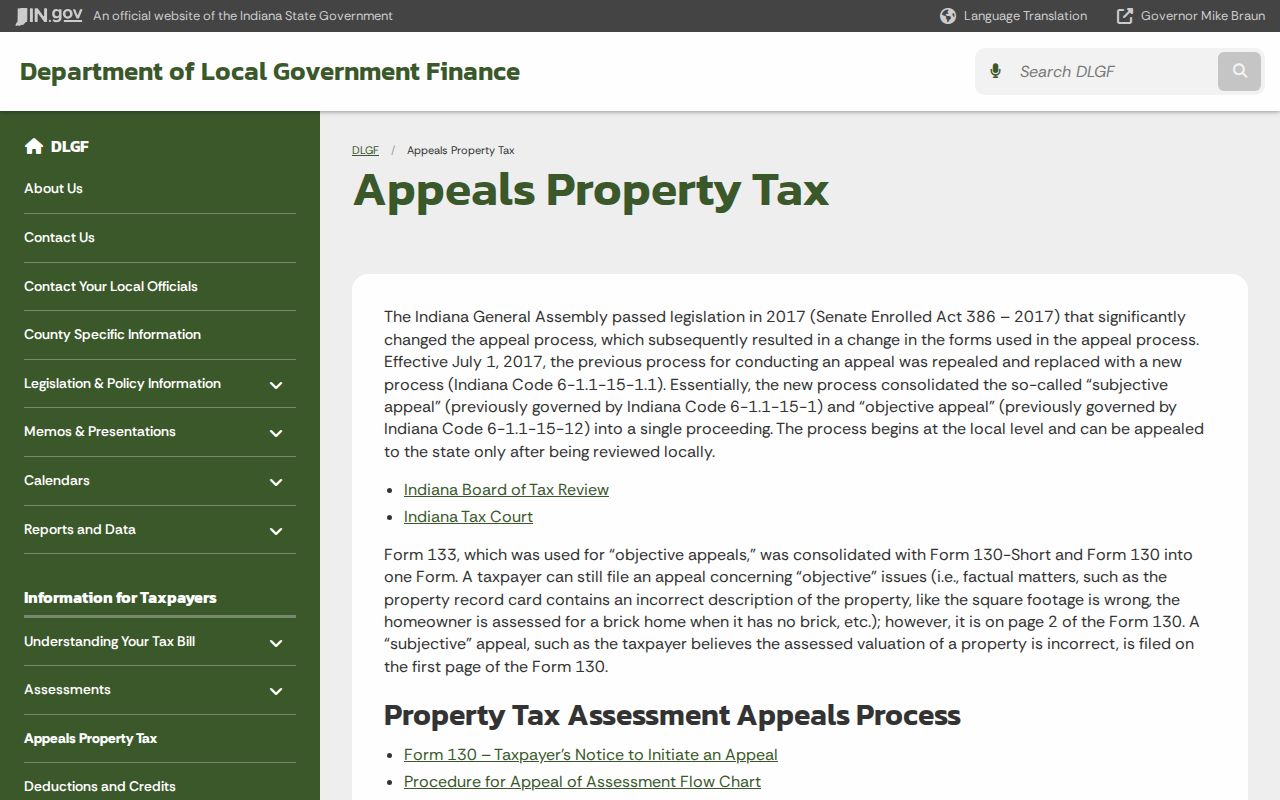
An appeal targets the assessment alone. It cannot settle deed ownership, an easement, or the legal location of a boundary.
Protect the deadline. Confirm the notice date and June 15 timing with Crawford's Assessor, then file one Form 130 per parcel through the instructed local channel.